





NanoALi · Patient selection
Which ligament injuries may suit NanoALi?
NanoALi is considered only after the specific ligament, injury grade, continuity, stability, associated damage and first-line rehabilitation have been defined.
 Reviewed byProfessor Paul Lee MBBch, FRCS (Tr & Orth), PhDCartilage and joint preservation expertise
Quick answer
Suitable partial or healing ACL, MCL, elbow UCL and ankle ATFL injuries may fit a non-surgical NanoALi pathway. Complete rupture, displaced avulsion or meaningful instability may need surgery; in that setting, NanoALi biology may be considered only as a separate adjunct to mechanical repair.
Verified across three networks
Trusted by patients on Doctify, Google and Top Doctors
Structural starting point
Start with the ligament, injury grade and mechanical stability
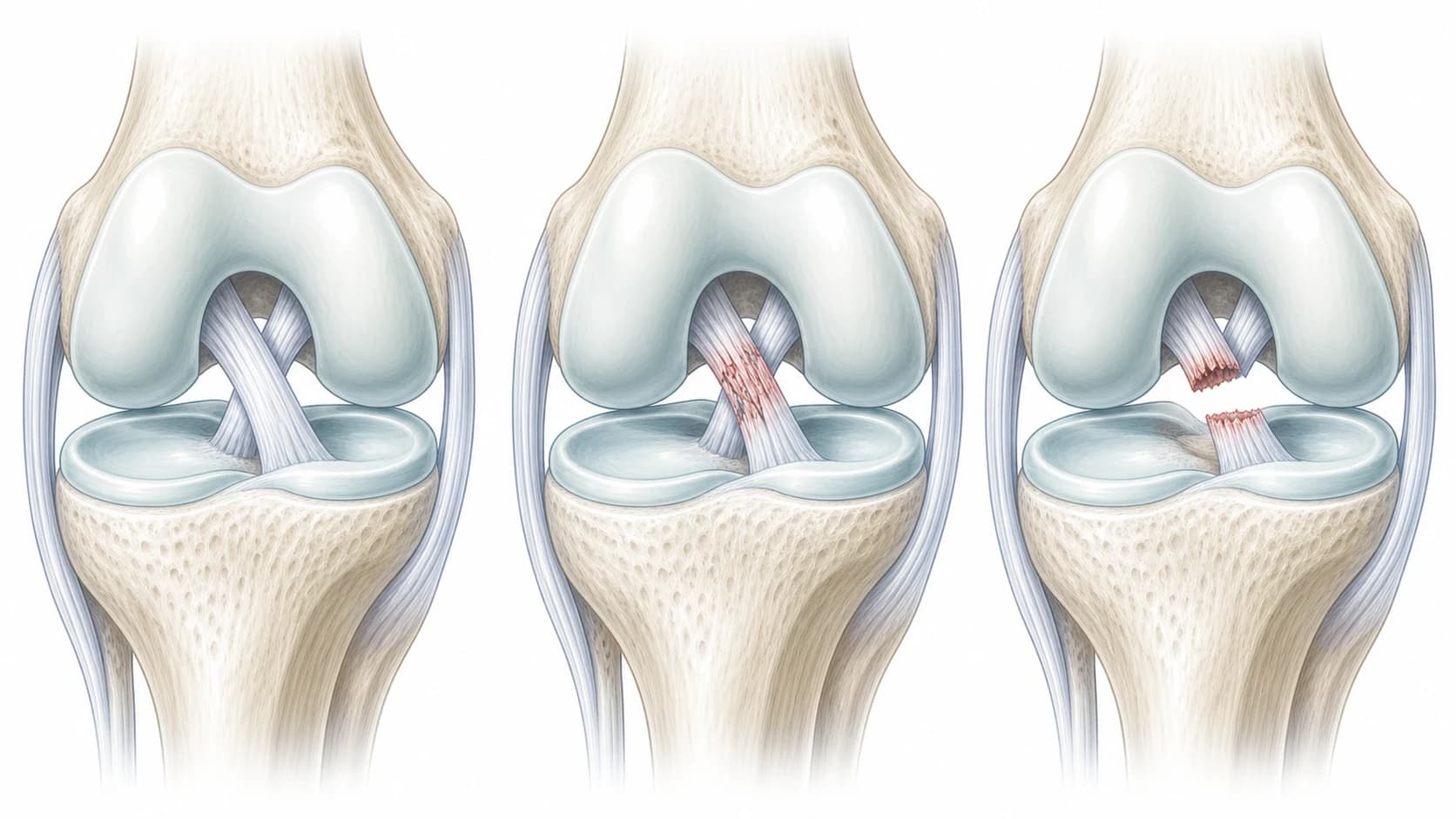
Stand-alone NanoALi may be considered for a suitable partial or healing ligament injury where useful fibres remain and the joint is not grossly unstable. Applications include the ACL and MCL at the knee, the elbow ulnar collateral ligament and lateral ankle ligaments such as the ATFL.
A complete rupture, displaced avulsion or gross instability may need repair or reconstruction. NanoALi cannot replace that mechanical work, although the biological components may be considered separately as an adjunct intended to support healing around a surgical repair.
- A defined ligament target on examination and imaging
- Useful fibre continuity remains
- Instability does not clearly require repair or reconstruction
- A structured protection and rehabilitation plan is possible
Assessment
The scan and the stability examination must agree
MRI defines deeper structures such as the ACL and associated joint injury. Ultrasound can assess accessible MCL, elbow UCL and ankle ligaments dynamically and guide delivery where the target is suitable.
Imaging cannot be read in isolation. Giving way, stress testing, swelling, timing, sport and the quality of previous rehabilitation all change what the same-looking scan means.
Reasons to change route
Instability is a mechanical warning, not just another symptom
Complete rupture, displaced avulsion, multi-ligament injury, recurrent giving way or an associated structural lesion may need a repair or reconstruction opinion. NanoALi alone cannot substitute for mechanical care; if surgery is required, any biological augmentation belongs inside that explicitly surgical plan.
Early protection, bracing where appropriate and progressive rehabilitation remain first-line elements for many ligament injuries. A biological procedure should address a defined gap in that plan rather than bypass it.

NanoALi suitability questions
Can NanoALi treat a complete ligament rupture?
Not as a stand-alone injection. The correct pathway may be structured non-operative rupture care, repair or reconstruction. Where surgery is required, NanoALi biology may be considered separately as an adjunct intended to support repair healing.
Does a partial ligament tear always need surgery?
No. Many partial injuries are managed without surgery. Injury grade, stability, associated damage, timing and functional demand determine the route.
Which ligaments may be assessed?
Suitable ACL, MCL, elbow ulnar collateral ligament and lateral ankle ligament injuries such as the ATFL may be assessed. Suitability is structure-specific and cannot be assumed from a generic diagnosis of sprain.
Is MRI always required?
Not for every superficial ligament injury, but MRI is important when deeper anatomy, multi-structure injury or cruciate damage must be defined. Ultrasound may be useful for accessible ligaments.
Still have more specific concerns?
Free Discovery CallOptions that our doctors may discuss include NanoACi, ChondroFiller, Mytocel MSK, joint replacement, established conservative care or surgery, depending on examination and imaging.
Define the ligament injury and mechanical stability
Professor Lee can combine examination and the right imaging to plan stand-alone NanoALi where appropriate or explain how repair and possible biological augmentation fit together.